
Nasomatto - Baraonda

Baraonda means chaos or uproar in Italian. It’s also the name of one of the the youngest fragrances in the Nasomatto line. Despite the name, there’s little chaos in the scent itself—though some of the notes may come as a surprise. What is truly surprising, however, is that Baraonda was created at all. Back in 2014, with the release of Blamage, Alessandro Gualtieri publicly announced the end of the Nasomatto project (and the beginning of a new one: Orto Parisi). Yet just two years later, a new Nasomatto composition saw the light of day—and it quickly stirred strong reactions, not all of them positive. Some time ago, I got my hands on a sample of Baraonda, and today—tinged with a bit of excitement—I’m sharing my review with you.
The opening of the composition is sweet and unexpectedly floral, with rose taking center stage. In Baraonda, Alessandro Gualtieri presents the flower in all its glory—full-bodied and mature. It's accompanied by ambrette seeds, also known as musk mallow, a plant often used in perfumery to replicate the scent of musk. And in this fragrance, it does so quite successfully. The ambrette not only enhances the muskiness but also contributes to the sweetness of the top notes, reinforcing the rosy accord. Still, Baraonda never becomes cloying. From the very beginning, a subtle bitterness emerges beneath the surface—one I couldn’t quite identify at first.
As the top notes fade, the first woody facets begin to emerge. Gualtieri’s creation reveals a distinct smoky aroma of burning woods. It’s not a single, clearly defined note—at times it hints at oud, at other times at rosewood—but overall, it remains somewhat elusive and abstract. In its heart, Baraonda occasionally reminded me of Palissandre d'Or by Aedes de Venustas, and at moments it even approached the territory of Santal Majuscule by Serge Lutens. That said, Baraonda is noticeably sweeter and less creamy than the latter. Around thirty minutes after application, the unmistakable note of whisky begins to surface—and with it, the source of the bitterness I noticed early on becomes clear. I should mention here that I generally can’t stand the scent of whisky; it strikes me as bitter and almost gasoline-like. Fortunately, in this fragrance, it’s not overwhelming, though it plays a central role. Its presence adds complexity and depth. Alongside it, a sweet and slightly tart note of red fruits emerges—most reminiscent of cranberries. In the base, everything settles into a generous dose of musk. Though enhanced with touches of vanilla and Ambroxan, the drydown ultimately loses much of the earlier richness. Gualtieri’s base feels relatively thin and brings forward some synthetic undertones that slightly undermine the overall experience.
The fragrance featured today on the blog comes in the form of an extrait de parfum, which gives it excellent performance qualities. Even with a modest application, Baraonda projects quite strongly—yet it’s surprisingly hard to overdo. Even when worn more generously, it somehow retains a sense of subtlety. As for longevity, it’s outstanding: on my skin, the scent lasted around 13 to 15 hours. Leaving the house in the morning, I had no doubt I’d still be able to smell it by evening.
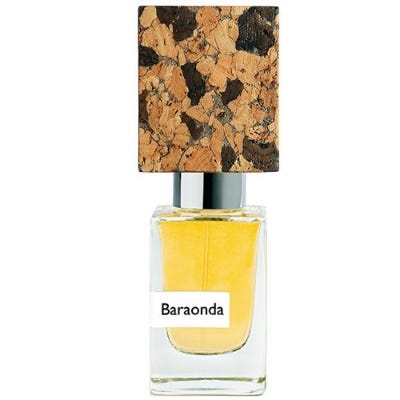
Say what you will, but to me these perfumes evoke a deep reddish-brown color. That’s why the bottle doesn’t quite match the scent in my mind. Baraonda comes in Nasomatto’s signature rectangular flacon, topped with a rather unusual cap resembling speckled corkwood. Why that particular design choice? That’s a question for Nasomatto’s marketing team. Still, I have to admit—the bottle certainly stands out. And that’s the point, isn’t it?
Much like Palissandre d'Or, Baraonda is a very well-crafted fragrance—but ultimately, it doesn’t quite align with my personal taste. Despite the whisky base, I find it a bit too sweet. And as I’ve mentioned, the whisky accord itself isn’t one of my favorites. That said, I must give credit where it’s due: especially in the opening, this scent offers a rich array of olfactory impressions. The composition feels smooth—almost silky—and sits pleasantly on the skin. Baraonda also undergoes a noticeable, though not abrupt or dramatic, evolution over time. It’s a shame Alessandro Gualtieri didn’t put a bit more effort into developing the base, which feels somewhat underwhelming. Still, I can see this fragrance appealing to many. Personally, I’d recommend wearing it especially at the cusp of autumn and winter.
Baraonda
Key notes: Whisky, Musk.
Author: Alessandro Gualtieri.
Year of creation: 2016.
My rating: Worth getting to know. (5/7)